
Meet the anoles
Natives and newcomers.
Each region has its own list, with native and introduced species kept separate. Photos come from iNaturalist observers under open licenses and are credited on each card. Species notes are in review; if you spot an error, tell us.
No AI-generated answers. Built from real sources and fixed rules.What this meansClose
When you use this tool, no AI writes your answer. The result comes from rules we set ahead of time, applied to information gathered from sources such as field guides, scientific records and our own courses. It is not made up on the spot.
AI did help us build it: writing code, organizing information and drafting some of the drawings.
Every anole you are likely to meet, with the throat fan, the look-alikes and where each one has been reported.
Show
United States
Jump to Puerto Rico and the U.S. Virgin Islands
Native
Native to the US, here long before people started moving anoles around.

Green Anole
Anolis carolinensis
Also called Carolina Anole; American Chameleon (a misnomer)
- Size
- Up to about 8 inches (20 cm) total length; most of that is tail.
- Dewlap
- Pink to strawberry red in males. Some populations in the western part of the range have a paler, almost whitish dewlap.
- How to tell it
- Slender, with a long pointed snout. Bright green when calm and warm, brown when cold, stressed or fighting, and anything between. Many females carry a pale stripe down the spine.
- Habits
- Lives from tree trunks up into the leaves, on shrubs, fences and house walls. Males bob their heads and flash the dewlap at rivals and mates. Eats insects and spiders.
- Where
- Native from North Carolina and Tennessee south through Florida and west to central Texas and Oklahoma. Introduced populations exist in Hawaii and elsewhere. Reported in 14 states, most often Texas, Florida, North Carolina, Louisiana and Georgia. About these counts
- Easily confused with
- The Cuban Green Anole (A. porcatus) looks almost identical; in South Florida assume either is possible. The Brown Anole never turns green, while a Green Anole does turn brown.
None of the native species fit this filter.
Nine more anoles have been introduced to the US see the introduced species
Introduced
Brought to the US by people and now found in the wild. Their native homes are on each card.

Brown Anole
Anolis sagrei
Also called Cuban Brown Anole; Bahaman Anole
Native to Cuba and the Bahamas.
- Size
- Up to about 8.5 inches (21 cm) total length; males are noticeably bigger and bulkier than females.
- Dewlap
- Orange to brick red with a pale yellow edge in males.
- How to tell it
- Brown, gray or nearly black, never green. Males can raise a low ridge (crest) along the back and have a thick-based tail. Females and young have a pale wavy or diamond-chain stripe down the back.
- Habits
- Perches low on trunks, fence posts, curbs and walls and runs to the ground for food. Bold and abundant; often the lizard people see most in Florida yards.
- Where
- Established across Florida and in parts of Georgia, Louisiana, Texas, Alabama, Mississippi, South Carolina and Hawaii, and spreading. First recorded in the Florida Keys in the 1880s. Reported in 27 states, most often Florida, Texas, Hawaii, Louisiana and Georgia. About these counts
- Easily confused with
- A brown-phase Green Anole has a longer snout, smooth back and can turn green again; the Brown Anole cannot.
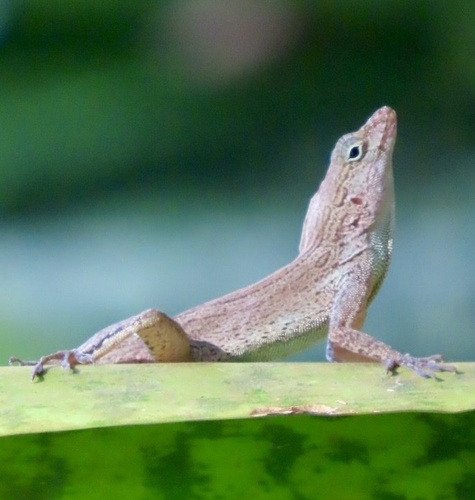
Crested Anole
Anolis cristatellus
Also called Puerto Rican Crested Anole
Native to Puerto Rico and the Virgin Islands.
- Size
- Males to about 3 inches (7.5 cm) from snout to vent, roughly 7 inches with the tail.
- Dewlap
- Olive to yellow-green with an orange or burnt-orange edge.
- How to tell it
- Gray-brown and stocky; adult males carry a fin-like crest along the tail and often along the back.
- Habits
- Trunk and ground, much like the Brown Anole, which it competes with where the two overlap.
- Where
- Established in Miami-Dade County since the mid-1970s and spreading locally. Reported in three states and territories: Florida, Puerto Rico and United States Virgin Islands. About these counts
- Easily confused with
- Easily taken for a Brown Anole; the tail crest and the greenish dewlap give it away.
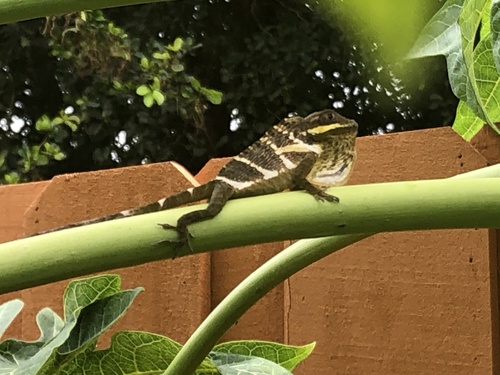
Knight Anole
Anolis equestris
Also called Cuban Knight Anole
Native to Cuba.
- Size
- The largest anole in the US: 13 to 20 inches (33 to 50 cm) total length.
- Dewlap
- Pale pink.
- How to tell it
- Bright green with a big bony head, a yellow or white stripe below the eye and another over the shoulder. Can turn dark brown.
- Habits
- Lives high in trees and comes down rarely. Eats insects, snails, fruit, and smaller lizards including other anoles. Will gape and bite if handled.
- Where
- Established across much of southern Florida since the 1950s, especially Miami-Dade, Broward and Palm Beach Counties. Reported in two states: Florida and Hawaii. About these counts
- Easily confused with
- Size alone separates adults from everything else. Young Knight Anoles still show the pale eye and shoulder stripes.
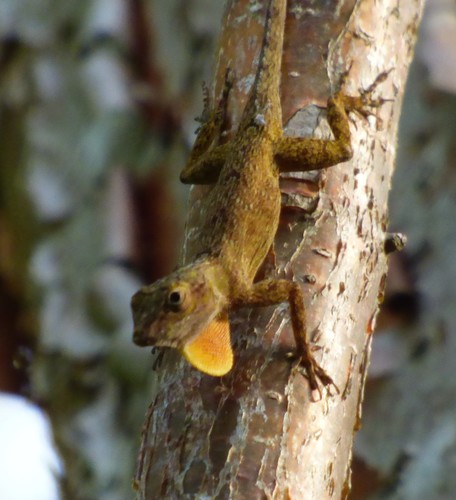
Bark Anole
Anolis distichus
Also called Hispaniolan Gracile Anole
Native to Hispaniola and the Bahamas.
- Size
- Small: about 3.5 to 5 inches (9 to 13 cm) total length.
- Dewlap
- Pale yellow, sometimes with an orange wash.
- How to tell it
- Gray to greenish-gray with dark chevrons or bands across the back and a flattened body. Changes shade quickly.
- Habits
- Hugs tree trunks head-down and moves in short dashes; rarely seen on the ground.
- Where
- Established in Miami-Dade and nearby counties since the 1940s. Reported in one state: Florida. About these counts
- Easily confused with
- Smaller and flatter than a Brown Anole, with banding rather than a back stripe.
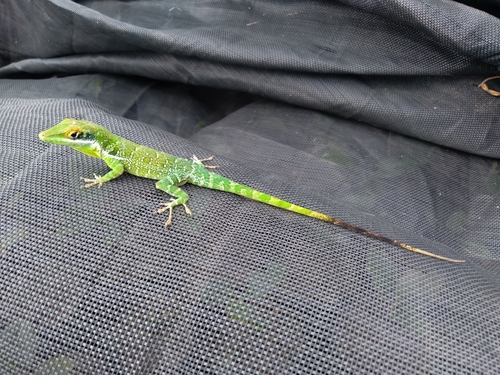
Hispaniolan Green Anole
Anolis chlorocyanus
Native to Hispaniola.
- Size
- Up to about 8 inches (20 cm) total length.
- Dewlap
- Dark blue to blue-black, unlike any other green anole in Florida.
- How to tell it
- Bright green, slender, much like a Green Anole, sometimes with a bluish cast around the head.
- Habits
- Trunk-crown: trunks up into the foliage of trees and shrubs.
- Where
- Established in small areas of Miami-Dade and Broward Counties. Reported in one state: Florida. About these counts
- Easily confused with
- Without the dewlap showing it is hard to separate from the Green and Cuban Green Anoles.

Cuban Green Anole
Anolis porcatus
Native to Cuba.
- Size
- Up to about 8 inches (20 cm) total length; a little heavier-built than the Green Anole.
- Dewlap
- Pink to purplish pink.
- How to tell it
- Green, often with pale flecks or short stripes on the body and a heavier head than the Green Anole. The two are so alike that experts sometimes need genetics.
- Habits
- Trunk-crown, like the native Green Anole.
- Where
- Established in Miami-Dade County since the 1990s. It interbreeds with the native Green Anole where they meet, which is one reason it matters. Reported in one state: Florida. About these counts
- Easily confused with
- The native Green Anole. In South Florida a green anole could be either.
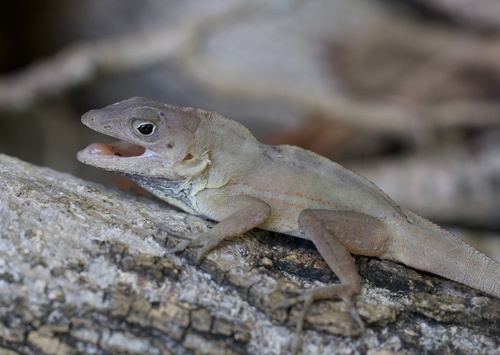
Largehead Anole
Anolis cybotes
Also called Hispaniolan Stout Anole
Native to Hispaniola.
- Size
- Males to about 7 inches (18 cm) total length; big-headed and stocky.
- Dewlap
- Pale yellow to cream, sometimes nearly white.
- How to tell it
- Brown or gray with a large head and a pale stripe along each side of the body.
- Habits
- Trunk and ground, like the Brown Anole.
- Where
- Established in small areas of Miami-Dade and Broward Counties. Reported in one state: Florida. About these counts
- Easily confused with
- A Brown Anole with an oversized head and a pale, not orange, dewlap.

Jamaican Giant Anole
Anolis garmani
Native to Jamaica.
- Size
- Large: males to about 12 inches (30 cm) total length.
- Dewlap
- Yellow-orange.
- How to tell it
- Bright green with a saw-toothed crest along the neck and back in males. Smaller and more slender than a Knight Anole, and without the pale face stripes.
- Habits
- High in trees, descending for prey.
- Where
- A small established population in Miami-Dade County; rarely encountered. Reported in one state: Florida. About these counts
- Easily confused with
- Knight Anole (bigger, pale face stripes, bony head).
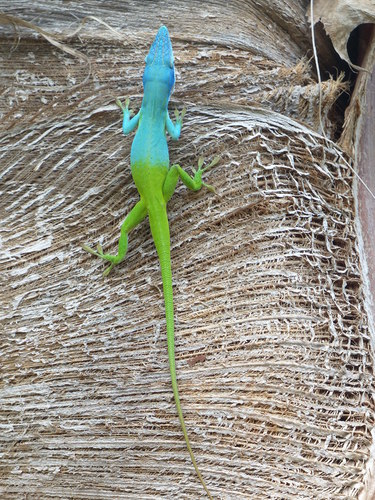
Allison's Anole
Anolis allisoni
Also called Cuban Blue Anole
Native to Cuba and islands off Honduras.
- Size
- Up to about 8 inches (20 cm) total length.
- Dewlap
- Pink to rose.
- How to tell it
- Adult males are unmistakable: a blue head and front half fading to green behind. Females and young are plain green and look like a Green Anole.
- Habits
- Trunk-crown, favoring palms and other open-canopy trees.
- Where
- A small established population in southern Florida. Reported in one state: Florida. About these counts
- Easily confused with
- Females and juveniles pass for Green Anoles; only adult males show the blue.
None of the introduced species fit this filter.
Puerto Rico and the U.S. Virgin Islands
Native
Native to Puerto Rico and the U.S. Virgin Islands, here long before people started moving anoles around.
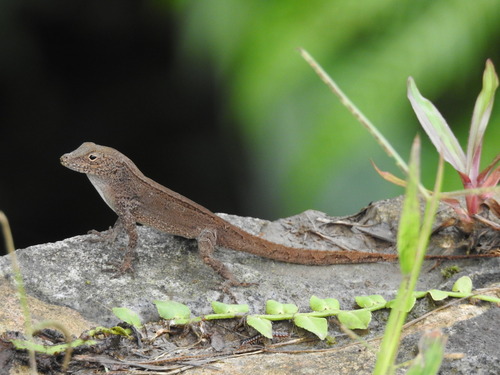
Crested Anole
Anolis cristatellus
Also called Puerto Rican Crested Anole; Common Puerto Rican Anole; Spanish: Abaniquillo caribeño crestado
- Size
- Males to about 3 inches (7.5 cm) from snout to vent; most females are much smaller.
- Dewlap
- In males, orange to red around the edge with a green or olive center. Virgin Islands males have a deeper red fan with a sharply marked green center, and on Puerto Rico's dry south coast the fan is often plain yellow-orange.
- How to tell it
- Stocky, brown to gray-green with faint darker spots, and able to shift from pale gray to almost black. Adult males have a tall fin along the top of the tail; females have a low one. Young ones are banded, and some females keep a pale stripe down the back.
- Habits
- Perches low on trunks, fence posts and walls, mostly within 6 feet (2 m) of the ground, and drops down to feed and lay eggs. Males bob, do push-ups and flash the dewlap at rivals.
- Where
- Almost everywhere in Puerto Rico, from towns and pastures to rainforest, and on Vieques, Culebra and many small islands nearby, but not Mona. In the Virgin Islands it lives on St. Thomas, St. John and the British islands. St. Croix has only a couple of records; its own anole is the Saint Croix Anole. People have carried it to Florida, the Dominican Republic, Costa Rica and Dominica. Records since 1980: Puerto Rico 7,727; St. Thomas and St. John 425. About these counts
- Easily confused with
- Gundlach's Anole (blue eyes, shady mountain forest), Cook's Anole (paler, only in the dry southwest) and, on St. Thomas and St. John, the introduced Brown Anole, whose males have no tail fin.
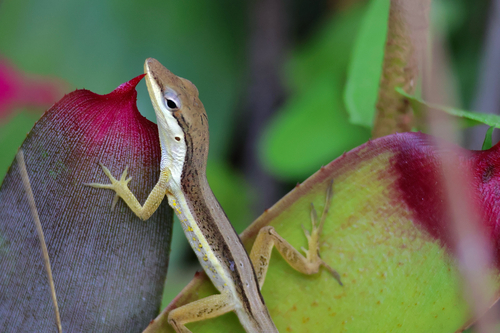
Puerto Rican Bush Anole
Anolis pulchellus
Also called Puerto Rican Anole; Snake Anole; Spanish: Lagartijo jardinero
- Size
- Small: about 1.4 to 1.7 inches (35 to 43 mm) from snout to vent, with a much longer tail.
- Dewlap
- Males: purple near the throat, turning crimson toward the edge.
- How to tell it
- Slender, with a very long tail. Yellow-brown with a pale stripe along each side from the mouth toward the tail.
- Habits
- Lives in grass and low shrubs in sunny, open places such as roadsides, pastures and trail edges. It has been seen jumping into water and swimming away from danger.
- Where
- One of the most common lizards in Puerto Rico, and found on Vieques, Culebra, St. Thomas, St. John and the British Virgin Islands. It does not live on St. Croix. Records since 1980: Puerto Rico 1,234; St. Thomas and St. John 67. About these counts
- Easily confused with
- Krug's Anole, which has an orange dewlap and likes cooler, shadier spots, and the Ponce Anole of the dry south coast, which has a small pale dewlap. Krug's and Puerto Rican Bush Anoles sometimes interbreed.
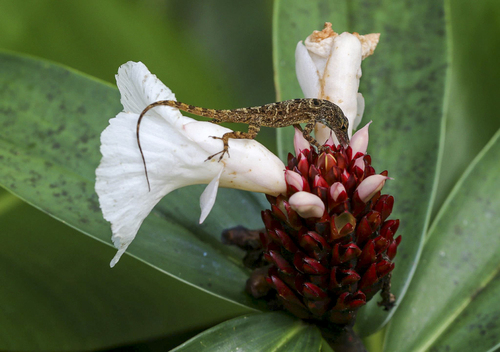
Banded Anole
Anolis stratulus
Also called Spotted Anole; St. Thomas Anole; Spanish: Lagartijo manchado
- Size
- Small: about 1.6 to 1.8 inches (40 to 46 mm) from snout to vent; the tail adds 2 to 3 inches.
- Dewlap
- Males: large and orange, turning yellow toward the edge. Females have a small gray fan with a little pale orange.
- How to tell it
- Gray to brownish gray with dark spots or bars down the back and a black crescent behind the eye. No crest. The pattern blends with lichen-spotted bark.
- Habits
- Lives from about 6 feet (2 m) up into the canopy, often in shade, and can be extremely abundant in the treetops. Eats mostly ants. Males are bold and flash the dewlap as people come close.
- Where
- Puerto Rico, Vieques, Culebra, St. Thomas, St. John and the British Virgin Islands. Often the most abundant anole at middle elevations in Puerto Rico. It does not live on St. Croix. Records since 1980: Puerto Rico 1,130; St. Thomas and St. John 102. About these counts
- Easily confused with
- Young Crested Anoles, which are stockier, sit lower on the trunk and lack the black crescent behind the eye.
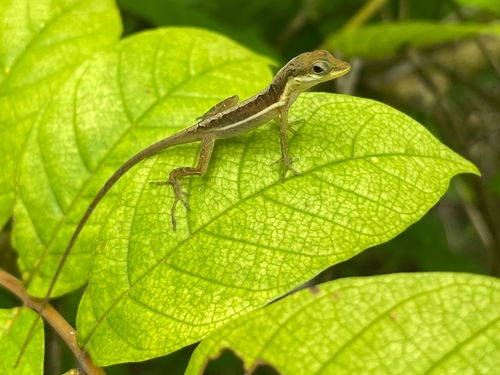
Krug's Anole
Anolis krugi
Also called Olive Bush Anole; Orange Dewlap Anole; Spanish: Lagartijo de las yerbas de la montaña
- Size
- Up to about 6.5 inches (17 cm) total length; the tail is more than twice as long as the body.
- Dewlap
- Orange, as its other name, Orange Dewlap Anole, says.
- How to tell it
- Slender and long-tailed, olive brown with a pale stripe along each side.
- Habits
- Grass, ferns and low shrubs at forest edges and in clearings. Eats insects and other small invertebrates.
- Where
- Puerto Rico only, from sea level to about 3,900 feet (1,200 m). Records since 1980: Puerto Rico 1,533. About these counts
- Easily confused with
- The Puerto Rican Bush Anole, which has a purple-to-crimson dewlap and favors hotter, sunnier spots.
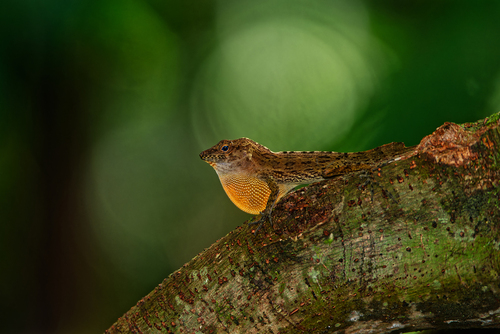
Gundlach's Anole
Anolis gundlachi
Also called Yellow-chinned Anole; Yellow-beard Anole; Spanish: Lagartijo barba amarilla
- Size
- Males to about 2.7 inches (68 mm) from snout to vent, females about 1.8 inches (45 mm).
- Dewlap
- Yellowish to orange.
- How to tell it
- Brown to olive brown with darker spots, and blue eyes. Males have a crest on the tail.
- Habits
- Perches low on big trunks in shady forest, rarely more than 16 feet (5 m) up, and often returns to the same sleeping spot night after night. Eats large insects and sometimes small frogs, snails and other anoles.
- Where
- Puerto Rico only: cool, wet forest in the mountains, such as El Yunque, mostly between about 800 and 3,800 feet (240 to 1,160 m). Records since 1980: Puerto Rico 1,069. About these counts
- Easily confused with
- The Crested Anole, which has brown eyes, an orange-and-green dewlap and is commoner in open, lower places.
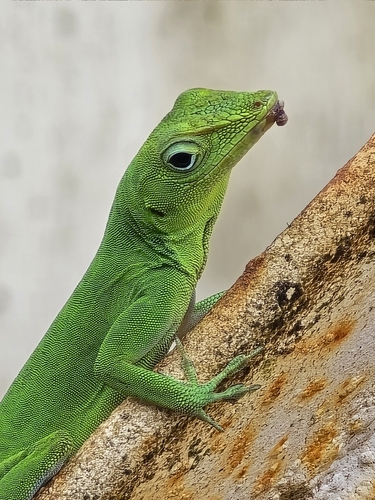
Emerald Anole
Anolis evermanni
Also called Evermann's Anole; Small Green Anole; Spanish: Lagartijo verde
- Size
- Males to about 2.8 inches (70 mm) from snout to vent, females about 1.8 inches (45 mm).
- Dewlap
- Yellow, in both males and females; larger in males.
- How to tell it
- Bright emerald green, turning dark brown when stressed. Flattened head and body, pointed snout, short legs and big toe pads.
- Habits
- Lives on upper trunks and branches, usually above 6 feet (2 m), and on boulders and bamboo. Sits and waits for insects, and has been seen sipping flower nectar. Males and females both defend territories.
- Where
- Puerto Rico only, in wet forest such as El Yunque and the central mountains. It is not found where the forest has been cleared. Records since 1980: Puerto Rico 1,330. About these counts
- Easily confused with
- The Puerto Rican Giant Anole, which is also green but far bigger, with a heavy, bony head.
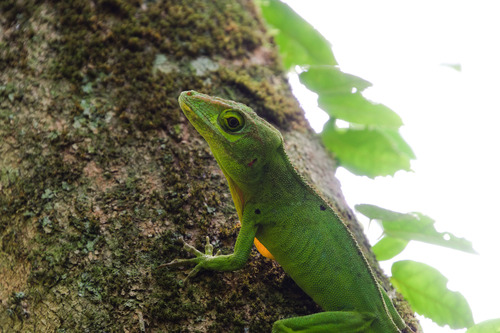
Puerto Rican Giant Anole
Anolis cuvieri
Also called Cuvier's Anole; Green Giant Anole; Spanish: Lagarto verde
- Size
- Puerto Rico's largest living anole: up to about 5 inches (13 cm) from snout to vent, plus a long tail.
- Dewlap
- Males: large and bright yellow. Females: smaller and light green.
- How to tell it
- Big and heavy-headed, green, with a jagged row of scales along the back and a crest on the tail. Big males can have sky-blue on the head, and the eye is ringed with yellow. Young ones are gray-brown with darker bars and turn green as they grow.
- Habits
- Lives high in the canopy of big trees and leaps from branch to branch; young ones stay lower, near the base of trees. Eats large insects, snails, fruit and sometimes other anoles and small birds. Bites hard if handled.
- Where
- Puerto Rico only, in forest with big trees, mostly wetter forest. It nearly vanished when much of the island was cleared in the early 1900s and came back as the forests regrew. Records since 1980: Puerto Rico 241. About these counts
- Easily confused with
- The Emerald Anole, which is green too but much smaller and slimmer.
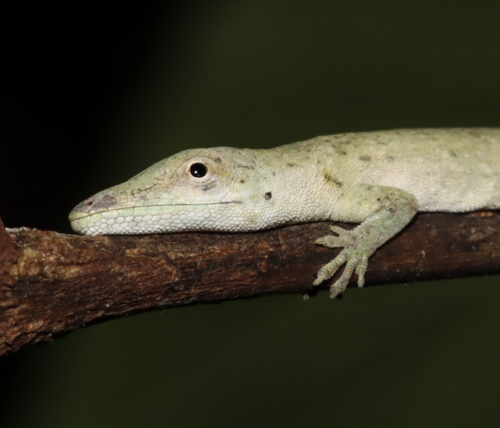
Dwarf Anole
Anolis occultus
Also called Puerto Rican Twig Anole; Limestone Anole; Spanish: Lagartijo enano
- Size
- The smallest anole in Puerto Rico: about 1.3 to 1.7 inches (34 to 42 mm) from snout to vent.
- Dewlap
- Described as pinkish gray. It folds away into a slot in the throat skin when not in use.
- How to tell it
- Tiny and slender, with very short legs and a long, narrow head. Mottled gray to olive brown with bands across the body; it can lighten or darken quickly. Males and females look alike.
- Habits
- Clings to thin twigs and vines from just above the ground to about 15 feet (4.5 m), near gaps in the canopy, and sleeps on twigs at night. Hard to find. Eats small insects and sometimes nectar.
- Where
- Puerto Rico only, mainly in the forested mountains of the center and west. Records since 1980: Puerto Rico 63. About these counts
- Easily confused with
- Young anoles of other species, which have longer legs and move quickly; the Dwarf Anole creeps.
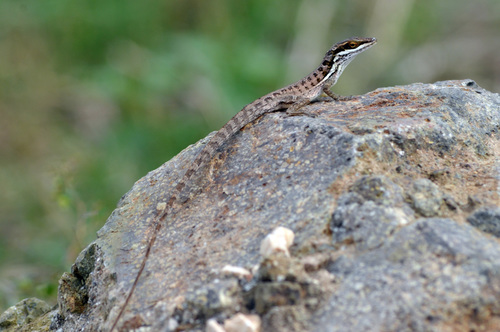
Ponce Anole
Anolis poncensis
Also called Ponce Small-fanned Anole; Dryland Grass Anole; Spanish: Lagartijo jardinero del sur
- Size
- Small: males up to about 1.7 inches (44 mm) from snout to vent, females about 1.6 inches (40 mm).
- Dewlap
- Small, as its other name says, and described as pale.
- How to tell it
- Long and slender, with a brownish back, greenish sides, blue eyes, a short pale stripe along the side and dark spots behind the eye.
- Habits
- Grass and low shrubs in dry, open country.
- Where
- Puerto Rico only, in the dry scrub and grassland of the south and southwest coast. Puerto Rico's Department of Natural and Environmental Resources lists it as vulnerable. Records since 1980: Puerto Rico 145. About these counts
- Easily confused with
- The Puerto Rican Bush Anole, which has a larger purple-to-crimson dewlap and lives all over the island.
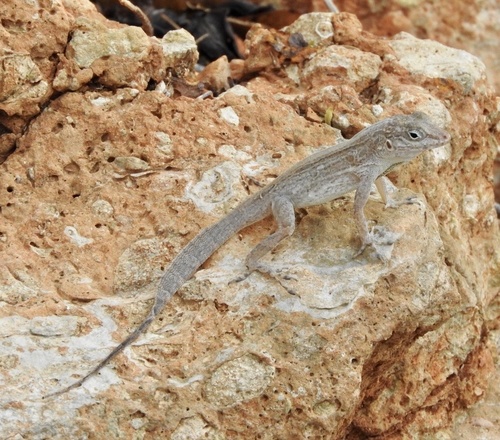
Cook's Anole
Anolis cooki
Also called Cook's Pallid Anole; Guánica Pallid Anole; Spanish: Lagartijo de bosque seco
- Size
- Males to about 2.8 inches (7 cm) from snout to vent, females about 2.4 inches (6 cm).
- Dewlap
- Males: brownish red to orange.
- How to tell it
- A pale, gray-brown relative of the Crested Anole.
- Habits
- Perches on trunks, branches and rocks in dry coastal forest and scrub, much as the Crested Anole does elsewhere.
- Where
- Only in the dry southwest of Puerto Rico, from sea level to about 330 feet (100 m), and on Caja de Muertos island. Listed as Endangered on the IUCN Red List. Records since 1980: Puerto Rico 167. About these counts
- Easily confused with
- The Crested Anole, which is darker and common almost everywhere else in Puerto Rico.

Mona Anole
Anolis monensis
Also called Spanish: Lagartijo de la Mona
- Dewlap
- Yellow-orange.
- How to tell it
- Very like a Crested Anole in build and color.
- Habits
- Lives much as the Crested Anole does on Puerto Rico, on trunks and other low perches.
- Where
- Only on Mona and neighboring Monito, in the Mona Passage between Puerto Rico and Hispaniola. It is the only anole there. Records since 1980: Puerto Rico 59. About these counts
- Easily confused with
- No other anole lives on Mona. It looks much like the Crested Anoles of Puerto Rico's dry south coast, which also have yellow-orange dewlaps.
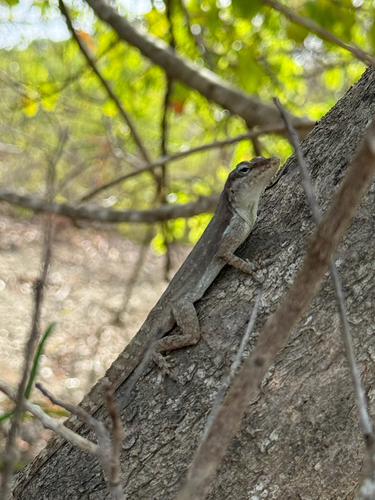
Desecheo Anole
Anolis desechensis
Also called Heatwole's Anole; Spanish: Lagartijo de Desecheo
- Size
- The male described in 1976 measured about 2.2 inches (57 mm) from snout to vent.
- Dewlap
- Plain yellow-orange.
- How to tell it
- Deep brownish gray above and paler below. Males have a slight crest on the neck and a tall crest along the first half of the tail.
- Habits
- Thought to live much as the Crested Anole does on Puerto Rico. Little has been written about its natural history.
- Where
- Only on Desecheo, a small island off Puerto Rico's west coast, where it is the only anole. Records since 1980: Puerto Rico 117. About these counts
- Easily confused with
- No other anole lives on Desecheo. Anywhere else it would pass for a Crested Anole.

Saint Croix Anole
Anolis acutus
Also called St. Croix's Anole; Sharp Anole; Spanish: Abaniquillo de Saint Croix
- Size
- Males average about 2.6 inches (67 mm) from snout to vent, females about 1.9 inches (49 mm).
- Dewlap
- White, with a large yellow-orange patch near the throat.
- How to tell it
- Plain tan to olive.
- Habits
- Perches on trees, bushes and posts from just above the ground to about 10 feet (3 m). Adults are territorial and keep young ones off their trees, so the young often live on the ground. Active from just before dawn to just after dusk.
- Where
- Only on St. Croix and the small cays near it (Buck Island, Protestant Cay and Green Cay), in dry and moist forest, pastures with trees, and yards. Records since 1980: St. Croix 114. About these counts
- Easily confused with
- The Crested Anole, which has been recorded on St. Croix only a couple of times.
Culebra Giant Anole
Anolis roosevelti
Also called Virgin Islands Giant Anole; Roosevelt's Giant Anole
- Size
- Large: up to about 6.3 inches (16 cm) from snout to vent.
- How to tell it
- Brownish gray rather than green, with a longer, more pointed and deeply grooved head than the Puerto Rican Giant Anole.
- Habits
- Lived high in fig and gumbo-limbo trees in dry forest and is thought to have fed on ripe figs.
- Where
- Known from eight museum specimens from Culebra, Vieques, Tortola and St. John. None has been collected since 1932, and long searches since then have found nothing. Still listed as endangered under the U.S. Endangered Species Act.
- Easily confused with
- Sightings reported since 1932 have turned out to be young Green Iguanas.
None of the native species fit this filter.
Introduced
Brought to Puerto Rico and the U.S. Virgin Islands by people and now found in the wild. Their native homes are on each card.
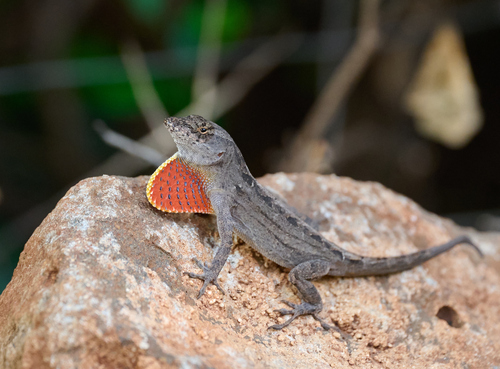
Brown Anole
Anolis sagrei
Also called Cuban Brown Anole; Spanish: Abaniquillo pardo del Caribe
Native to Cuba and the Bahamas.
- Size
- Up to about 8.5 inches (21 cm) total length; males are noticeably bigger and bulkier than females.
- Dewlap
- Orange to brick red with a pale yellow edge in males.
- How to tell it
- Brown, gray or nearly black, never green. Males can raise a low ridge along the back and have a thick-based tail. Females and young have a pale wavy or diamond-chain stripe down the back.
- Habits
- Perches low on trunks, posts and walls and runs to the ground for food.
- Where
- Introduced and now established on St. Thomas and St. John. There are no confirmed records from Puerto Rico or St. Croix. Records since 1980: St. Thomas and St. John 36. About these counts
- Easily confused with
- The Crested Anole, which shares St. Thomas and St. John with it; male Crested Anoles have a tall fin on the tail and a red-and-green dewlap.
None of the introduced species fit this filter.
Try Whose Dewlap Is This? Anole questions answered
Sources
- Krysko, K. L., et al. 2016. New verified nonindigenous amphibians and reptiles in Florida through 2015, with a summary of over 152 years of introductions. Reptiles & Amphibians 23(2): 110–143.
- The Reptile Database (Anolis species accounts, June 2026 release, CC BY)
- Florida Museum of Natural History, Herpetology: Florida's lizards
- Losos, J. B. 2009. Lizards in an Evolutionary Tree: Ecology and Adaptive Radiation of Anoles. University of California Press.
- SSAR Standard English and Scientific Names, 9th ed. (2025)
- Peterson Field Guide to Reptiles and Amphibians of Eastern and Central North America, 4th ed. (Powell, Conant & Collins)
- Uetz, P., & Hosek, J. (2026). The Reptile Database, version 2026-06 (distribution, common names and ecomorph comments), via ChecklistBank dataset 1008. CC BY.
- Heatwole, H. 1976. Herpetogeography of Puerto Rico. VII. Geographic variation in the Anolis cristatellus complex in Puerto Rico and the Virgin Islands. Occasional Papers of the Museum of Natural History, University of Kansas 46: 1–18.
- Anole Annals: Variation and distribution of Anolis roosevelti (JMIH 2016); Anolis desechensis (2013); #DidYouAnole: Anolis pulchellus (2021); St. Croix posts
- EDGE of Existence: Roosevelt's giant anole
- Wikipedia species articles for the Puerto Rico and Virgin Islands anoles (sizes and natural history; checked against the sources above where they overlap)
- iNaturalist taxon pages and establishment means for Puerto Rico, the U.S. Virgin Islands and St. Croix (Spanish common names)
- GBIF occurrence records, 1980–2026 (record counts per island group)
About the state counts: they are GBIF occurrence records, and they include strays, escaped or released pets and misdated records. They show where a species has been reported, not where it has an established population.
About the Puerto Rico and the U.S. Virgin Islands counts: GBIF occurrence records with coordinates from 1980 to 2026, split into Puerto Rico (with Vieques, Culebra, Mona and Desecheo), St. Thomas and St. John (with their cays), and St. Croix; places with fewer than 3 records are left out. Counts include strays, misidentified and misdated records, so they show where a species has been reported, not its established range.
Photos are from iNaturalist observers under Creative Commons licences; each credit links to the observation.
Species copy is in review; tell us if you spot an error.
Go deeper
Keep learning with a course.
Everything on this page is free to use. If you would like to go further, our courses are self-paced and grounded in science, with no deadlines, and the free one is a good place to start.
Certified Herpetological Guide
Self-paced · $149.00
View Full Details
Certified Junior Herpetologist
Self-paced · $109.00
View Full Details
Foundations of Herpetological Husbandry
Self-paced · $49.00
View Full Details
Starting and Running a Reptile & Amphibian Rescue
Self-paced · $35.00
View Full Details
Coexisting With Wild Snakes
A free course on living alongside snakes: the myths, the biology, why identification rules fail, and what to actually do.
Self-paced · Free
View Full DetailsFree, and staying that way
Help keep these tools running
This tool, the free snakes course, the Primer and everything on our Resources page will always be free. If it helped you and you would like to help keep it running (and help us build the next one), you can pitch in. Everything given goes to LEARN, the nonprofit rescue that runs The Herpetology Collective, so it also helps feed, house and care for the animals we take in.