Fieldwork should make you a more attentive observer, not a bigger disturbance.
The Herpetology Collective asks students to approach reptiles and amphibians as wild animals first: observe carefully, leave habitat functioning the way you found it, protect sensitive information, and choose the safest option for both you and the animal.
Nothing in the CHG fieldwork requires you to catch, touch, restrain, collect, keep, or relocate a reptile or amphibian.
Observe first
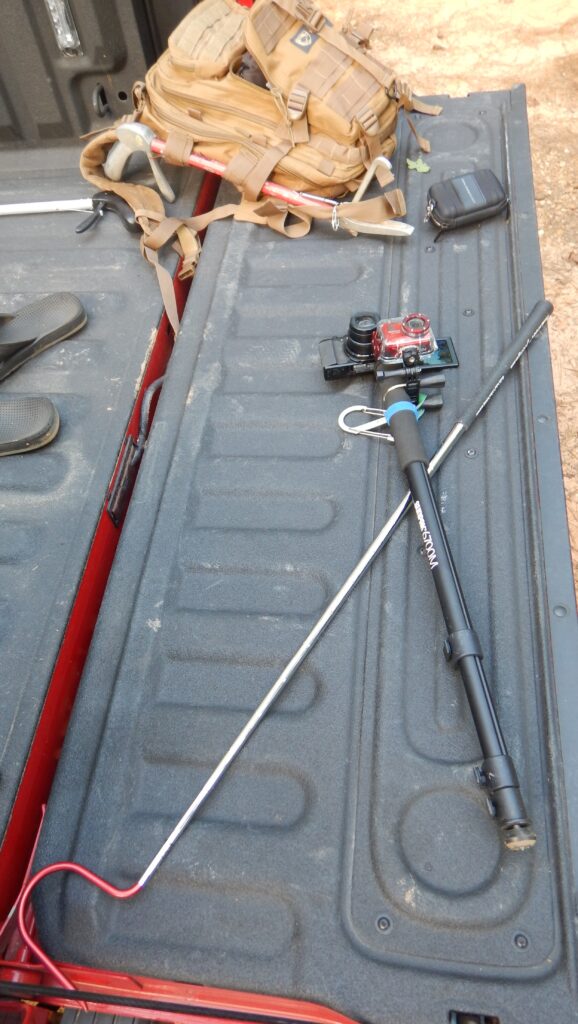
For coursework, an in-situ observation — seeing or photographing an animal where it already is — is enough.
Do not handle an animal just to improve a photograph, get a measurement, prove an identification, or complete an assignment. Never handle a venomous, dangerous, or unidentified animal for coursework.
If an animal moves away, disappears under cover, or otherwise ends the encounter, let it.
Leave habitat as habitat
Many herps spend much of their lives under logs, rocks, bark, leaf litter, artificial cover, or other small refuges. Moving those objects can expose the animal and change the tiny temperature and moisture conditions it was using.
If you carefully lift natural cover to look beneath it, keep disturbance brief and return the cover as closely as practical to its original position. Do not dismantle logs, tear bark from trees, drain pools, dig animals from retreats, or substantially rearrange habitat for an observation.
A missed photograph is cheaper than damaged habitat.
Protect sensitive locations
Location data can be scientifically useful and conservation-sensitive at the same time.
Be especially cautious with exact coordinates for rare, imperiled, commercially valuable, denning, nesting, breeding, or otherwise vulnerable animals. Use the geoprivacy/obscuring tools available in citizen-science platforms when appropriate.
Also remember that photographs themselves can reveal locations through embedded GPS/EXIF metadata, recognizable road signs or buildings, landmarks, trail or park names, captions, and social-media location tags.
The goal is not to make useful records useless. It is to give useful information to the people who need it without advertising a sensitive locality to everyone else.
Biosecurity: don’t carry one site to the next
Mud, water, footwear, nets, containers, tools, and other equipment can move pathogens among populations.
When visiting multiple aquatic or amphibian sites, treat biosecurity as part of the field trip rather than an afterthought:
- remove soil, mud, plant material, and other debris from footwear and equipment;
- clean and disinfect gear between sites when disease transmission is plausible;
- follow current agency, land-manager, research-project, or Partners in Amphibian and Reptile Conservation guidance for the animals and pathogens in your region;
- allow equipment to dry completely when the applicable protocol uses drying as part of decontamination; and
- do not move water, substrate, animals, plants, or biological material between sites unless you are specifically authorized and using an appropriate protocol.
Different pathogens respond differently to disinfectants. That is why THC does not prescribe one universal bleach recipe for every field situation.
Current PARC disease resources
Know the rules where you are
Wildlife laws are local.
The rules can change by country, state or province, county or parish, species, season, landowner, park, refuge, research purpose, or type of interaction. A species that may be photographed freely on one site may be protected from handling on another.
Before fieldwork, check both the wildlife regulations for your jurisdiction and the rules for the specific property or land manager you are visiting.
Do not assume that public access means every wildlife activity is permitted. Likewise, never enter private property without permission.
THC assignments can be completed without collecting specimens or handling wildlife. If a location would require an activity you are not permitted or comfortable doing, choose another location or request an alternative assignment.
Roads and vehicles
Roads can be productive places to observe reptiles and amphibians, especially during seasonal movements, but traffic changes the safety equation completely.
Your priority around any roadway is avoiding a collision or creating a hazard.
- Do not stop where you cannot get fully and legally out of traffic.
- Do not stand in an active travel lane for a photograph.
- Wear appropriate high-visibility gear when conditions call for it.
- Do not trespass because an animal crossed onto private property.
- Never make an abrupt maneuver that puts people at risk in order to reach an animal.
- Follow all traffic, parking, and land-access laws.
THC does not require road cruising or road-based observations. If it is not safe or legal where you are, use another observation method.
Sick or dead wildlife
An unusual sick or dead reptile or amphibian can be valuable information, especially when disease is a concern.
Photograph the animal and record the location and circumstances from a safe distance when practical. Avoid casual handling. A wildlife agency, university researcher, veterinarian, museum, or disease-reporting program may have specific instructions about whether and how a specimen should be collected.
PARC herpetofaunal disease and reporting resources
Venomous encounters
The safest field technique for a venomous snake is wonderfully low-tech: give it space.
You do not need to catch, move, pin, hook, pose, or closely approach a venomous snake for this course. A photograph is optional; your safety is not.
If a venomous snakebite occurs, treat it as a medical emergency. In the United States, current CDC/NIOSH guidance says to seek emergency medical care and avoid outdated measures such as ice, tourniquets, cutting or suctioning the wound, electric shock, or commercial venom-extractor devices.
CDC/NIOSH venomous snake guidance
Students elsewhere should follow the emergency guidance and poison/toxicology resources appropriate to their country.
Young learners
A parent or guardian is responsible for the safety of a minor during fieldwork.
That does not mean an adult needs special herpetological expertise. It means the adult controls where the activity happens, whether conditions are safe, and whether an observation should be abandoned.
If an activity is not appropriate for a particular learner, use a published alternative or request one.
Accessibility and alternatives
Some assignments already include alternate ways to reach the same learning objective.
If your location, disability, health, transportation, season, finances, safety, technology, or another circumstance makes the standard route impractical, you may request an equivalent alternative. You do not need to provide a diagnosis, documentation, or a detailed justification.
The destination is the learning objective. The route can change.
A short field ethic
When in doubt:
Observe more. Disturb less. Protect the location. Leave the habitat working. Go home safe.