Whose shed is this?
Identify a shed snake skin.
Found a shed and wondering who left it? Answer a few questions about the skin itself (the scales under the tail, the plate over the vent, the ridges on the back, a row count) and this key narrows the possibilities to the snakes that actually live where you found it, showing its reasoning at every step. Skip any question you can’t answer. Free, and in beta.
Loading the key…
How it works
A shed keeps the scales, and the scales tell the story.
Color and pattern fade on a shed, but every scale is still there, and a handful of scale characters separate the families of North American snakes cleanly. Our vipers have a single row of scales under the tail; every other snake has two. Whether the plate over the vent is single or divided, whether the back scales are ridged or smooth, and how many rows run around the body then sort the rest. Add where you found it, and the list gets short.
Before you start
Gently unroll the shed and turn it right-side-out if it came off inside out (most do). Lay it on a plain dark surface in daylight. A magnifying glass or your phone’s close-up mode helps with the scale details.
Three photos settle most sheds
The top of the head, the side of the head from nostril to eye, and the underside of the tail just past the vent. If you ask for help anywhere, these three pictures are what an experienced eye needs.
What the key can’t do
A shed rarely settles a species on its own, especially among closely related snakes, and it can’t tell you whether the snake is still around. Treat the result as a short list, and use the “what would separate them” hints to finish the job.
The method follows Andrew Durso’s guide to identifying snake sheds (Life is Short, but Snakes are Long, 2012), and the species characters were compiled from the Peterson field guides, with a citation on every candidate. Found a snake instead of a shed? What Lives Near Me lists everything on record for your county.
Go deeper
Turn a name into understanding.
The key tells you who might have left the shed. The courses teach how those animals live, how to tell them apart, how to care for them, and how to talk about them with people who are afraid of them. Every course is self-paced and grounded in science; one is free, and the rest are priced to stay within reach.
Free
Coexisting With Wild Snakes
For anyone who shares space with snakes
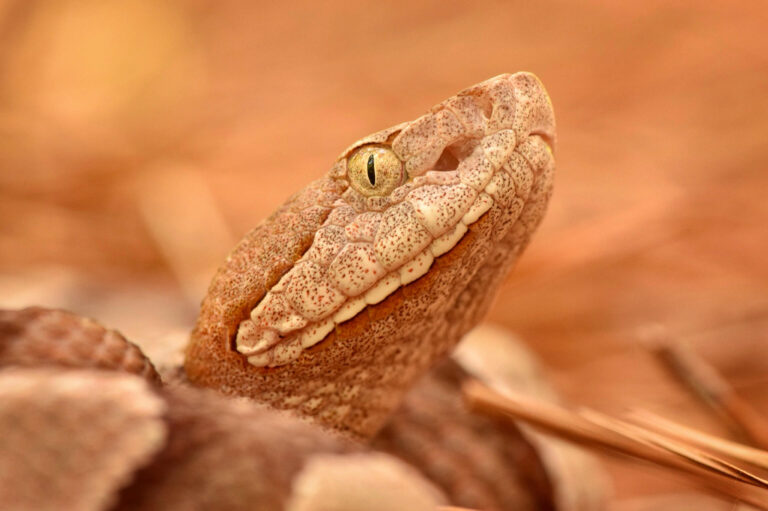
A free course on living alongside snakes: the myths, the biology, why identification rules fail, and what to actually do.
Self-paced · about 5 hours · Free
View Full Details
Open for enrollment
Certified Herpetological Guide
For adults
Covers the biology and the conservation, then pushes further: how to talk about these animals with people who are afraid of them.
Self-paced · about 50 hours · $149.00
View Full Details
Open for enrollment
Certified Junior Herpetologist
For teens and tweens
The certification track written at a younger reading level, with adult-partnered fieldwork.
Self-paced · about 30 hours · $109.00
View Full Details
Coming soon
Foundations of Herpetological Husbandry
For people who keep reptiles and amphibians
Science-based care for reptiles and amphibians in human care.
Self-paced · about 8 hours · $49.00
View Full Details
Coming soon
Starting and Running a Reptile & Amphibian Rescue
For people starting or running a rescue
What it takes to run a reptile and amphibian rescue, including whether wildlife rehabilitation is a path you want to pursue.
Self-paced · about 6 hours · $35.00
View Full Details